Buy gildafc.eu ?
We are moving the project
gildafc.eu .
Are you interested in purchasing the domain
gildafc.eu ?
domain@kv-gmbh.de · 0541-91531010
Buy gildafc.eu ?
What does inhomogeneous and homogeneous mean?
Inhomogeneous refers to something that is not uniform or consistent throughout, such as a mixture with uneven distribution of its components. For example, a soil with varying levels of nutrients can be considered inhomogeneous. On the other hand, homogeneous refers to something that is uniform or consistent throughout, such as a solution with evenly distributed components. For instance, a well-mixed sugar-water solution can be considered homogeneous. **
What are homogeneous and inhomogeneous media in physics?
Homogeneous media in physics are materials that have uniform properties throughout, such as density, refractive index, or conductivity. This means that any physical quantity measured at any point within the material will be the same. In contrast, inhomogeneous media have varying properties throughout, leading to spatial variations in physical quantities. Examples of inhomogeneous media include a mixture of different materials, or a material with a gradient in its properties. Understanding the behavior of light, sound, or other waves in homogeneous and inhomogeneous media is important in various fields of physics and engineering. **


Similar search terms for Inhomogeneous
Top-Angebote
Products related to Inhomogeneous:
-
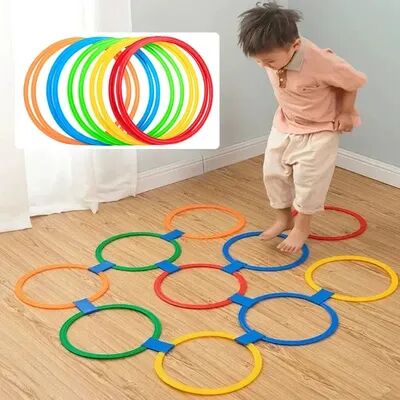
Perfect Picks Market Piece Agility Training Rings Set For Speed Drills Football Training Equipment 10pcs ATurn every outdoor session into an exciting fitness challenge with these agility training rings designed for all ages. Whether you're coaching a team or keeping kids active, this versatile set transforms simple drills into fun, skillbuilding games....34,97 $*Shipping: 0,00 $Secure redirect to the provider
-
Healfit Counter Home Fitness Equipment, Abdominal Muscle Roller, ABS, Muscle Training, Weight Loss, Core Strength, Gym Accessories Home Fitness Equipment, Abdominal Muscle Roller, ABS, Muscle Training, Weight Loss, Core Strength, Gym AccessoriesTransform your home workouts with the Abdominal Muscle Roller crafted from durable ABS material. Designed to maximize your core strength, this versatile home fitness equipment is perfect for anyone looking to tone their abs, strengthen muscles, and...23,97 $*Shipping: 0,00 $Secure redirect to the provider
-
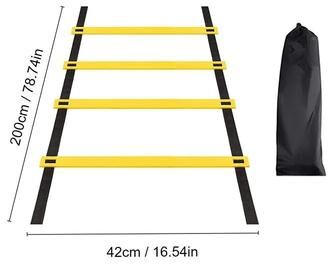
Uplift Picks Adjustable Agility Ladder Speed Training Equipment For Football And Fitness 200 CmBoost your speed, coordination, and performance with dynamic training. This agility ladder is designed to help athletes improve footwork, balance, and quickness in every session. Made for both beginners and advanced users, its perfect for sports...61,48 $*Shipping: 0,00 $Secure redirect to the provider
-
Perfect Picks Market Piece Agility Training Rings Set For Speed Drills Football Training Equipment 10pcs BTurn every outdoor session into an exciting fitness challenge with these agility training rings designed for all ages. Whether you're coaching a team or keeping kids active, this versatile set transforms simple drills into fun, skillbuilding games....39,97 $*Shipping: 0,00 $Secure redirect to the provider


-
Is it a homogeneous or an inhomogeneous field?
The question is not specific enough to determine whether the field is homogeneous or inhomogeneous. In physics, a homogeneous field is one that has the same value at every point in space, while an inhomogeneous field varies in value from point to point. Without more information about the specific field in question, it is not possible to determine whether it is homogeneous or inhomogeneous. **
-
How do you solve an inhomogeneous differential equation?
To solve an inhomogeneous differential equation, one typically uses the method of undetermined coefficients or variation of parameters. In the method of undetermined coefficients, one assumes a particular form for the solution and then solves for the unknown coefficients. In the variation of parameters method, one assumes a particular form for the solution and then solves for the unknown parameters by substituting the solution back into the original differential equation. Both methods involve finding a particular solution to the inhomogeneous equation and then adding it to the general solution of the corresponding homogeneous equation. **
-
How does an electron behave in an inhomogeneous field?
In an inhomogeneous field, an electron will experience a force that varies in direction and magnitude depending on its position within the field. This can cause the electron to accelerate, decelerate, or change direction as it moves through the field. The electron's trajectory will be influenced by the spatial variation of the field, leading to complex and non-uniform motion. Overall, the electron's behavior in an inhomogeneous field is characterized by its response to the changing forces acting on it as it moves through the field. **
-
How do you solve a second-order inhomogeneous differential equation?
To solve a second-order inhomogeneous differential equation, one can use the method of undetermined coefficients or variation of parameters. The method of undetermined coefficients involves finding a particular solution to the inhomogeneous equation by assuming a form for the solution and then solving for the coefficients. Variation of parameters involves finding a particular solution by assuming a solution of the homogeneous equation and then using the method of variation of parameters to find a particular solution. Once the particular solution is found, the general solution to the inhomogeneous equation can be obtained by adding the particular solution to the general solution of the corresponding homogeneous equation. **

What is the second-order difference equation for an inhomogeneous equation?
The second-order difference equation for an inhomogeneous equation is of the form \(y[n] - a_1y[n-1] - a_2y[n-2] = x[n]\), where \(y[n]\) represents the output sequence, \(x[n]\) represents the input sequence, and \(a_1\) and \(a_2\) are constants. This equation describes how the current output value \(y[n]\) is related to the previous two output values \(y[n-1]\) and \(y[n-2]\), as well as the current input value \(x[n]\). The inhomogeneous term \(x[n]\) represents any external influences or disturbances acting on the system. **
What is the difference equation of second order for an inhomogeneous equation?
The difference equation of second order for an inhomogeneous equation can be represented as: y[n] - a1*y[n-1] - a2*y[n-2] = x[n] where y[n] represents the current output, y[n-1] and y[n-2] represent the previous outputs, a1 and a2 are constants, and x[n] represents the input signal. This equation describes how the current output is related to the previous outputs and the input signal in a second-order system with inhomogeneous terms. **
Top-Angebote
Products related to Inhomogeneous:
-
All Categories Goods Agility Speed Training Ladder For Football Footwork & Fitness Heavy Duty Exercise Equipment Agility Speed Training Ladder For Football Footwork & Fitness Heavy Duty Exercise EquipmentBoost your agility and footwork with this 8rung agility ladder, designed to take your fitness and football training to the next level. Whether you're an athlete or a fitness enthusiast, this training ladder will enhance your speed, coordination, and...47,97 $*Shipping: 0,00 $Secure redirect to the provider
-
Perfect Picks Market Piece Agility Training Rings Set For Speed Drills Football Training Equipment 10pcs ATurn every outdoor session into an exciting fitness challenge with these agility training rings designed for all ages. Whether you're coaching a team or keeping kids active, this versatile set transforms simple drills into fun, skillbuilding games....34,97 $*Shipping: 0,00 $Secure redirect to the provider
-
Healfit Counter Home Fitness Equipment, Abdominal Muscle Roller, ABS, Muscle Training, Weight Loss, Core Strength, Gym Accessories Home Fitness Equipment, Abdominal Muscle Roller, ABS, Muscle Training, Weight Loss, Core Strength, Gym AccessoriesTransform your home workouts with the Abdominal Muscle Roller crafted from durable ABS material. Designed to maximize your core strength, this versatile home fitness equipment is perfect for anyone looking to tone their abs, strengthen muscles, and...23,97 $*Shipping: 0,00 $Secure redirect to the provider
-
What does inhomogeneous and homogeneous mean?
Inhomogeneous refers to something that is not uniform or consistent throughout, such as a mixture with uneven distribution of its components. For example, a soil with varying levels of nutrients can be considered inhomogeneous. On the other hand, homogeneous refers to something that is uniform or consistent throughout, such as a solution with evenly distributed components. For instance, a well-mixed sugar-water solution can be considered homogeneous. **
-
What are homogeneous and inhomogeneous media in physics?
Homogeneous media in physics are materials that have uniform properties throughout, such as density, refractive index, or conductivity. This means that any physical quantity measured at any point within the material will be the same. In contrast, inhomogeneous media have varying properties throughout, leading to spatial variations in physical quantities. Examples of inhomogeneous media include a mixture of different materials, or a material with a gradient in its properties. Understanding the behavior of light, sound, or other waves in homogeneous and inhomogeneous media is important in various fields of physics and engineering. **
-
Is it a homogeneous or an inhomogeneous field?
The question is not specific enough to determine whether the field is homogeneous or inhomogeneous. In physics, a homogeneous field is one that has the same value at every point in space, while an inhomogeneous field varies in value from point to point. Without more information about the specific field in question, it is not possible to determine whether it is homogeneous or inhomogeneous. **
-
How do you solve an inhomogeneous differential equation?
To solve an inhomogeneous differential equation, one typically uses the method of undetermined coefficients or variation of parameters. In the method of undetermined coefficients, one assumes a particular form for the solution and then solves for the unknown coefficients. In the variation of parameters method, one assumes a particular form for the solution and then solves for the unknown parameters by substituting the solution back into the original differential equation. Both methods involve finding a particular solution to the inhomogeneous equation and then adding it to the general solution of the corresponding homogeneous equation. **
Similar search terms for Inhomogeneous
-
Uplift Picks Adjustable Agility Ladder Speed Training Equipment For Football And Fitness 200 CmBoost your speed, coordination, and performance with dynamic training. This agility ladder is designed to help athletes improve footwork, balance, and quickness in every session. Made for both beginners and advanced users, its perfect for sports...61,48 $*Shipping: 0,00 $Secure redirect to the provider
-
Perfect Picks Market Piece Agility Training Rings Set For Speed Drills Football Training Equipment 10pcs BTurn every outdoor session into an exciting fitness challenge with these agility training rings designed for all ages. Whether you're coaching a team or keeping kids active, this versatile set transforms simple drills into fun, skillbuilding games....39,97 $*Shipping: 0,00 $Secure redirect to the provider
-
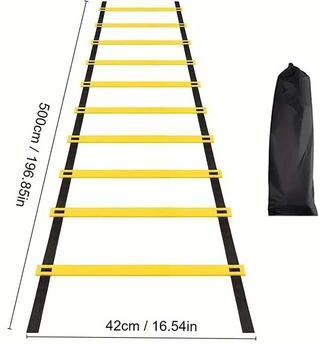
Uplift Picks Adjustable Agility Ladder Speed Training Equipment For Football And Fitness 500 CmBoost your speed, coordination, and performance with dynamic training. This agility ladder is designed to help athletes improve footwork, balance, and quickness in every session. Made for both beginners and advanced users, its perfect for sports...63,98 $*Shipping: 0,00 $Secure redirect to the provider
-
Uplift Picks Adjustable Agility Ladder Speed Training Equipment For Football And Fitness 7 MBoost your speed, coordination, and performance with dynamic training. This agility ladder is designed to help athletes improve footwork, balance, and quickness in every session. Made for both beginners and advanced users, its perfect for sports...65,48 $*Shipping: 0,00 $Secure redirect to the provider
-
How does an electron behave in an inhomogeneous field?
In an inhomogeneous field, an electron will experience a force that varies in direction and magnitude depending on its position within the field. This can cause the electron to accelerate, decelerate, or change direction as it moves through the field. The electron's trajectory will be influenced by the spatial variation of the field, leading to complex and non-uniform motion. Overall, the electron's behavior in an inhomogeneous field is characterized by its response to the changing forces acting on it as it moves through the field. **
-
How do you solve a second-order inhomogeneous differential equation?
To solve a second-order inhomogeneous differential equation, one can use the method of undetermined coefficients or variation of parameters. The method of undetermined coefficients involves finding a particular solution to the inhomogeneous equation by assuming a form for the solution and then solving for the coefficients. Variation of parameters involves finding a particular solution by assuming a solution of the homogeneous equation and then using the method of variation of parameters to find a particular solution. Once the particular solution is found, the general solution to the inhomogeneous equation can be obtained by adding the particular solution to the general solution of the corresponding homogeneous equation. **
-
What is the second-order difference equation for an inhomogeneous equation?
The second-order difference equation for an inhomogeneous equation is of the form \(y[n] - a_1y[n-1] - a_2y[n-2] = x[n]\), where \(y[n]\) represents the output sequence, \(x[n]\) represents the input sequence, and \(a_1\) and \(a_2\) are constants. This equation describes how the current output value \(y[n]\) is related to the previous two output values \(y[n-1]\) and \(y[n-2]\), as well as the current input value \(x[n]\). The inhomogeneous term \(x[n]\) represents any external influences or disturbances acting on the system. **
-
What is the difference equation of second order for an inhomogeneous equation?
The difference equation of second order for an inhomogeneous equation can be represented as: y[n] - a1*y[n-1] - a2*y[n-2] = x[n] where y[n] represents the current output, y[n-1] and y[n-2] represent the previous outputs, a1 and a2 are constants, and x[n] represents the input signal. This equation describes how the current output is related to the previous outputs and the input signal in a second-order system with inhomogeneous terms. **
* All prices are inclusive of VAT and, if applicable, plus shipping costs. The offer information is based on the details provided by the respective shop and is updated through automated processes. Real-time updates do not occur, so deviations can occur in individual cases. ** Note: Parts of this content were created by AI.